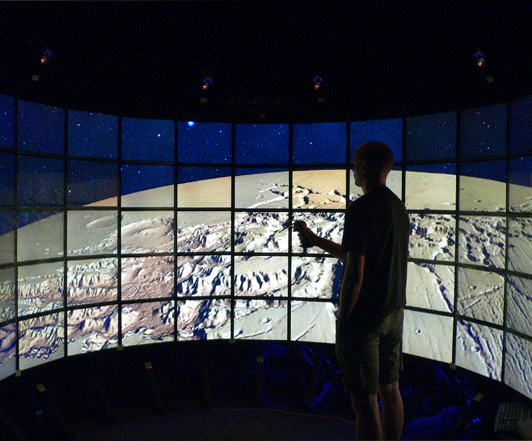
Camera Based Automatic Calibration for the Varrier System
Varrier is a head-tracked, 35-panel tiled autostereoscopic display system which is produced by The Electronic Visualization Laboratory (EVL) at the University of Illinois at Chicago (UIC). Varrier produces autostereoscopic imagery through a combination of a physical parallax barrier and a virtual barrier, so that the stereoscopic images are directed correctly into the viewers eyes. Since a small amount of rotation and translation between physical and virtual barriers can cause large-scale effects, registration is critical for correct stereo viewing. The process is automated by examining image frames of two video cameras separated by the interocular distance as a simulation of human eyes. Three registration parameters for each panel are calibrated in the process. An arbitrary start condition is allowed and a robust stopping criterion is used to end the process and report results. Instead of exhaustive three dimensional searching, an efficient two phase calibration method is introduced. The combination of a heuristic rough calibration and an adaptive fine calibration guarantees a fast searching process with the best solution.
About Todd
My research represents a formal inquiry into the friction between users and data. By architecting novel hardware and algorithms, these projects establish new benchmarks for how we visualize and interact with massive, multi-dimensional datasets.
Learn More